Trees and shrubs
Trees fail after planting for a short list of reasons: the hole was dug too deep, circling roots were never cut, the backfill will not drain, mulch was piled against the trunk, or the tree went dry through its first Houston summer.
Where new trees fail
The hole was dug deeper than the root ball, so the tree settles and the flare ends up buried. Circling roots from a long stay in the pot were never cut, so they keep circling. The backfill will not drain, which is a real risk in Houston's clay, since clay compacts and restricts both root growth and water movement. Mulch was piled against the trunk. Or nobody watered it through the first summer.
The hole, and what goes back in it
Dig the hole two to four times the width of the root ball and only as deep as the ball. A wide, shallow hole lets roots move out sideways, which is where they want to go. A deep hole lets the tree sink.
The backfill is where the material decision happens. Casco's own guidance is to mix the soil you removed 1:1 with compost or an enriched blend before it goes back in. Tree & Shrub Mix is the blend made for this job: sandy loam topsoil, Casco Compost and humus, so it feeds the root ball and still drains.
Before the tree goes in, slide it out of the container and look at the roots. If it is root-bound, cut vertically down the sides of the ball and across the bottom to break the circling roots. Set the ball level, fill to the top of the ball, and stake with T-posts so wind cannot rock it while roots establish.
How mulch goes around a trunk
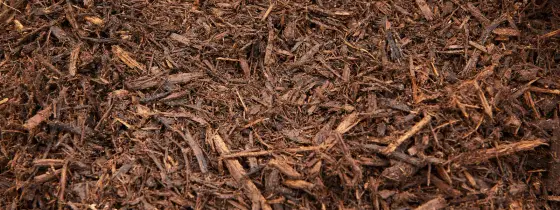
Two to four inches of finished mulch. It can come up close to the trunk, but never over it, and never over exposed roots, which are part of how the tree breathes. Mulch piled against bark holds moisture against the trunk and invites rot.
On a new planting the ideal is to run the mulch all the way out to the edge of the canopy, because the roots run to the canopy edge and a little beyond and that is what holds the tree steady. A mature tree does not need it, because those roots have already gone deep.
The mulch is not feeding the tree. It adds no NPK. It holds moisture and steadies soil temperature, and as it breaks down it adds humus to the soil. Compost is what adds nutrients.
When to plant
Any time it is not freezing. There is no narrow window in Houston.
A plant does better in the ground than in a pot. A pot holds a thin layer of soil with ambient air all the way around it, so it dries out fast in heat. The ground insulates the root ball and holds the moisture in.
Shrub beds
Most shrubs are hardy, which is why Tree & Shrub Mix exists: sandy loam topsoil, Casco Compost and humus, blended so a shrub gets stability and a good root system into the ground. It is not the mix for delicate flowering plants.
The first year
Keep the soil moist without drowning it. Water deeply once a week for the first year rather than a little every day. Shallow watering keeps roots at the surface.
Keep the bed mulched through the first summer and the first winter. Steady soil temperature and steady moisture are most of what a new planting needs. Do not fertilize when it is cold or when it is very hot.