
How we make mulch, soil blends, and compost
We take in local green waste, compost and age it on site, and screen it before it is sold.
Inputs
What goes into the piles
For mulch: single grind, which is rough-ground land-clearing material run through a grinder once, from local land-clearing and tree work.
For Casco Compost, three inputs in the order we say them: wood shavings, animal manure, and food waste. The manure is horse manure collected from stables around Houston, plus rodeo manure. The food waste is fruit, vegetable, meat, and dairy, brought to the yard by food waste collection companies.
Texas regulates a compost yard by what it takes in, not by what it sells. Meat and dairy move an operation out of the exempt tier into the notification tier, which means notifying every adjacent landowner through the TCEQ before any of it can be composted. Nobody objected, and TCEQ cleared us to compost. We are registered with TCEQ under the notification tier.
Stephen Flowers on what that took: "The meat and dairy requires an NOI notification through TCEQ to all adjacent landowners. They said that would take six weeks. It took nine months."
For dyed red mulch, the wood is clean kiln-dried two-by-fours, sorted by hand. No chemically treated wood, no paint, no plywood.
Time
Longer than the state minimum
The state minimum for pathogen kill in windrow composting is 15 days at 131 F with five turnings, under 30 TAC 332.23. The 15 days is a pathogen standard. It says the pile got hot enough for long enough to kill weed seed and pathogens. It does not say the material has finished breaking down. That is curing, and it takes months. We hold material for months, and some products for years.
Casco Compost is made in small batches. Large producers take in so much feedstock that windrows have to be turned and pushed off the pad to make room for the next load. We cook ours out in the windrows, move it to static curing piles, and let it finish mellowing before it is used.
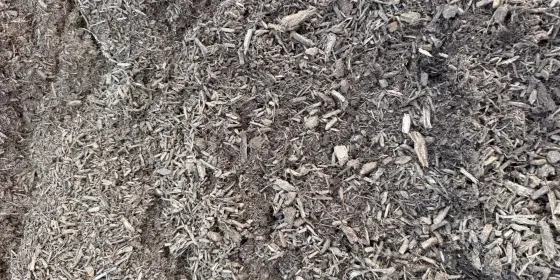
Mulch grinding is exempt from Texas composting rules. Nothing requires wood to age at all before it is sold as mulch. Aged Native Mulch ages three to six months anyway and is flipped twice in that time, and we water the pile with sprinklers through dry stretches.
We make and age material before the orders exist.
In the windrows
Heat, air, and water
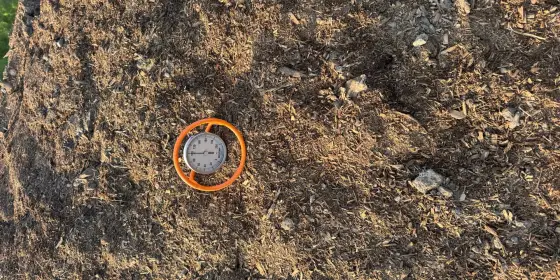
Mike Conner takes the temperature of the windrows and keeps them between 130 and 160 F. Above 160, the heat starts to kill the microbes that do the work. Below 130, the pile is short on oxygen and the microbes are starving. Either way, the row gets turned.
The turner is a machine the loader hooks onto and drives through the row, one side and then the other. It mixes the row and puts fresh air into it. The temperature drops right after a turn and is back up within about a day.
A windrow should be neither too wet nor too dry. A pile that dries out loses its heat and goes cold, so in dry weeks the water truck comes through and soaks the rows down.
Screening
A trommel is a rotating drum with sized holes
Finished product runs through our trommels. Compost and soil blends finish at half-inch minus: anything larger is caught and sent to the overs pile. Aged Native Mulch is screened through a trommel, run through the grinder twice more, and finished through a 1.5 inch screen.
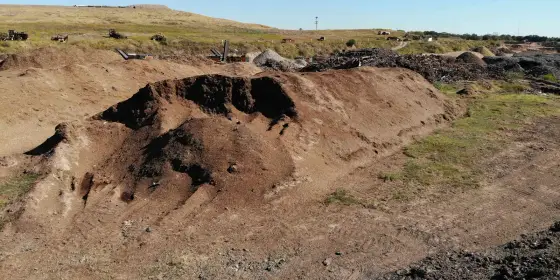
When we screen bank sand, the clay chunks come out and go on a pile of their own.
Trash rides in with feedstock. When brush arrives, the crew picks trash out of it by hand. Whatever is left in the compost is caught by the trommel and sent out with the overs, which is why the finished product comes out clean.
Recycling
Food waste collection companies bring in the food waste
Casco Compost is wood shavings, animal manure, and food waste. The food waste is fruit, vegetable, meat, and dairy, brought to the yard by food waste collection companies. Taking meat and dairy moves a Texas composting operation into a regulated tier, so we are registered with TCEQ under the notification tier.
Material that would otherwise be thrown away leaves the yard as compost, and it goes back into the same part of Houston it came from.
Finished or not
How to tell finished material from unfinished
Compost gets tested before it is sold. We pull finished compost one section at a time, and before each section is pulled we run a Solvita compost maturity test on it. One paddle reads the carbon dioxide the compost gives off and the other reads ammonia. A section is finished when the carbon dioxide paddle shows purple, for low carbon dioxide, and the ammonia paddle shows yellow, a 5, the lowest ammonia reading. The next section gets its own test when we reach it.
Mulch we judge by look, feel, and smell. Finished mulch and compost both smell like earth. A vinegar, ammonia, sulfur, or silage smell means the material is still fermenting.
Compost that is not finished keeps breaking down after it is spread, and it pulls nutrients out of the soil around it to do that. In a garden or flower bed, that is the opposite of what compost is for.
The smell comes from how the pile was handled. Wood piled deep and never turned goes anaerobic and ferments. UMass Extension documents what that produces: pile pH falling to 1.8 to 2.5, against near-neutral for properly composted mulch, plus acetic and butyric acid, methanol, ammonia gas, and hydrogen sulfide. Spread on a bed, plants can wilt within half an hour, and by the next day the foliage is bleached.
The same check works at a counter. Take a handful off the pile and smell it before you buy. Product that is hot at the point of sale is still composting.
Common questions
Taking meat and dairy food waste. That moves a Texas composting operation out of the exempt tier and into the notification tier. We filed the notification with every adjacent landowner, nobody objected, and we are registered with TCEQ under the notification tier.
Months, and some products for years. Aged Native Mulch ages three to six months and is flipped twice in that time. Casco Compost cooks in windrows, then cures in static piles until it has finished.