
Soil · Houston
How screening works
Topsoil comes out of the ground with clay chunks, rocks and clumps in it. Bank sand comes out of our pits with clay in it too. Once either one is spread and graded, the texture you have is the texture you keep. So we screen it first.
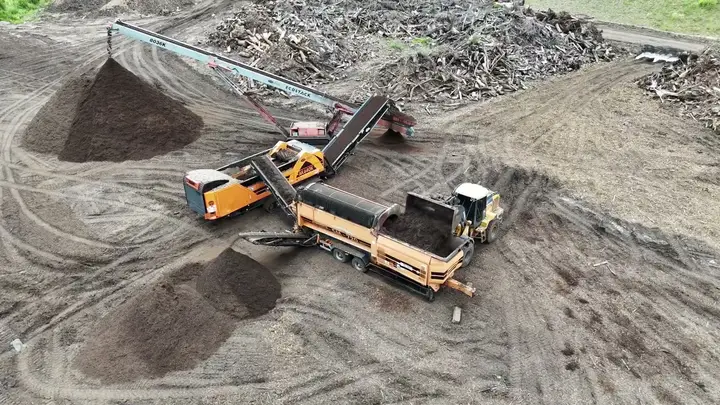
A sideways washing machine
The machine in the clip is a trommel. We have three of them on the yard. It is a rotating drum with sized holes, and a loader feeds it from one end. The drum tumbles what is in it. Fine material drops through the holes. Anything too big to fit stays behind and goes to its own pile.
Stephen Flowers, our Vice President of Operations and Development, puts it this way: "We do a front-end loader into our trommel, which is the screener. I describe it as a sideways washing machine."
What half-inch minus means
There is no one screen. We swap it for the job. Our finish for compost and soil blends is half-inch minus. Anything half an inch or smaller goes through. Anything bigger is caught and goes to the overs pile.
Mulch is finished coarser. Aged Native Mulch goes through a trommel after it ages, then through the grinder twice more, and comes out through a 1.5 inch screen.
What ends up on the overs pile
It depends on what went in. Screened Sandy Loam Topsoil is straight topsoil dug on our property. Run it to half-inch minus and what the screen catches is clay and rock.
Bank sand comes out of our pits with clay chunks in it. Those chunks hold water and resist grading, so sand that still has them in it is hard to get even.
Stephen Flowers: "When we screen it, the chunks of clay come out and go to that giant mountain."
Compost is a different case. What the screen catches there is trash that rode in with the feedstock. Whatever trash is left in it comes out with the overs.
Why it has to happen before the load goes out
Once soil is spread and graded, you cannot practically change its texture. You can adjust pH and add nutrients later. Texture is fixed.
A fine, consistent mix spreads evenly when you topdress, and it gives seed and sod even contact with the soil. A coarse or rocky mix does not spread evenly and leaves lumps in the turf.
Screening is an extra step, and it is why unscreened sand costs less.
Whatever you order, ask what it was screened to.