
Mulching · Houston
Proper mulch application for your garden beds
Fall and spring are the best times to re-dress beds. Over the season, mulch decomposes from rain and heat. That is normal: the wood breaks down and feeds soil microbes.
Prepare the bed
Remove weeds that have sprouted. A string trimmer knocks them down. For heavy weed pressure, cover the area with cardboard (tape and labels off). The cardboard blocks light to the weed seed underneath while the mulch goes on top. Rough up any compacted mulch so the old layer and the new layer knit together.
Choose finished mulch
Every mulch does the same base job: it steadies soil temperature, holds moisture, and helps suppress weeds. Cedar also carries its own insect-repelling character, and the dyed mulches hold their color for about a season. Past that, pick on appearance: natural brown, dyed black or red, or cedar. That is what you will be looking at for the next six months.
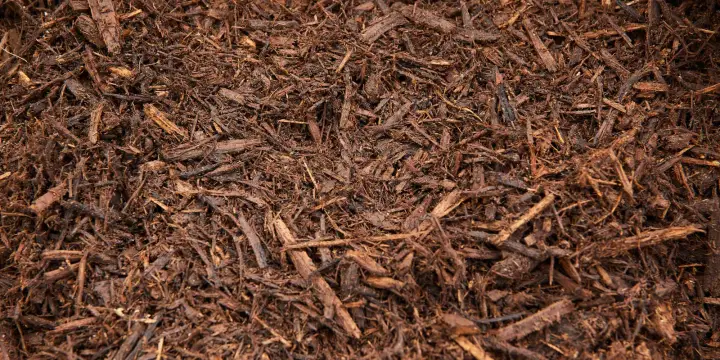
Use finished material. Aged Native Mulch is native hardwood, ground, aged three to six months on our yard, and finished through a 1.5 inch screen. It should smell like earth, not vinegar or ammonia.
On the dyed mulches, the wood under the color is what matters. Ours is clean kiln-dried dimensional lumber, picked through by hand. No chemically treated or painted wood, and no plywood.
How deep, and how far from the trunk
Add a 2 to 4 inch layer. Mulch can come up close to a trunk, but never over it, and never over exposed roots. Those roots are part of how the tree breathes, and mulch piled against bark holds moisture against the trunk and invites rot.
Around a newly planted tree, the ideal is to carry the mulch out to the edge of the canopy at the same 2 to 4 inches. The root system runs to the canopy edge and a little beyond. Most people put a narrow ring around the trunk instead because it looks tidy, and a mature tree does not need more than that because its roots have gone deep.
What mulch does, and what it does not
Mulch is not a fertilizer. It adds no NPK. It holds moisture and keeps soil temperature steady, cooler in heat and warmer in cold, and as it breaks down it adds humus to the soil.
Feeding is a compost job. A quarter-inch topdressing of Casco Compost on a lawn or worked into a bed is what adds nutrients, trace minerals and organic matter.
One cubic yard covers about 100 square feet at 3 inches deep, or about 80 square feet at 4 inches. Run your own numbers in the Yard calculator.
Re-dress beds in spring or fall. Spring starts as soon as it is not cold, sometimes February and sometimes March, and runs until it gets hot. Fall picks up once temperatures drop into the 80s.