Mulching in Houston
Mulch regulates soil temperature, holds moisture, and suppresses weeds - when it is finished material, applied at the right depth, and kept off the trunk.
Nothing requires mulch to be finished before it is sold
Mulching operations are exempt from the Texas composting rules (30 TAC 332.3). Nothing requires wood to age at all before it goes out as mulch. Anyone with a grinder can sell mulch the week it was ground.
Fresh wood piled high and never turned goes anaerobic and ferments. UMass Extension documents what that produces: pile pH falling to 1.8 to 2.5, against near-neutral for properly composted mulch, plus acetic, propionic and butyric acid, methanol, ammonia gas, and hydrogen sulfide. Spread on a bed, plants can wilt within half an hour, and by the next day the foliage is bleached.
Finished mulch smells like earth or fresh-cut wood. Vinegar, ammonia, sulfur, or silage means it is still fermenting.
What aging does, and what it takes
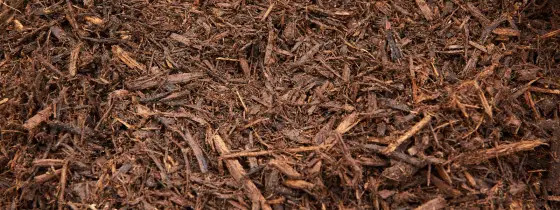
Aged Native Mulch starts as single grind, rough-ground land-clearing material that arrives from tree jobs across the Houston area. It is ground, then aged three to six months and flipped twice in that time, then run through a trommel screen and back through the grinder twice more, finished through a 1.5 inch screen.
Stephen Flowers, standing at the aging pile: "That orange hose on top is a big sprinkler, so when it's not raining enough we water the pile as part of the aging process."
Black mulch is that same aged native mulch, dyed. Red mulch is different material: clean dimensional lumber, dyed, and it cannot be aged as long or it will not hold the color. On either one, plan on the color holding a season. The dye maker rates it for at least a year, and a sprinkler system running three times a week bleaches it faster than a bed that only gets rain.
What is under the dye
Iron-oxide and carbon-black colorants are benign. In testing, iron oxide actually reduced arsenic leaching. The hazard in a dyed mulch is the wood. Mulch ground from construction and demolition debris can contain CCA-treated lumber: 18 of 22 samples taken from C&D facilities leached arsenic above Florida's groundwater target, and less than 0.1 percent CCA wood in a mix is enough to exceed residential clean-soil arsenic guidance.
Stephen Flowers on what goes into Casco's dyed mulch: "We don't use any chemically treated or painted wood or plywood, only clean kiln-dried two-by-fours, so we pick through all of it."
Ask any supplier what wood is under the dye. If the answer is "recycled wood", ask what wood. Casco's answer is clean kiln-dried dimensional lumber.
Depth, distance from the trunk, and when to re-dress
Two to four inches in a bed. Mulch can come up close to a trunk, but never over it, and never over exposed roots. Those roots are part of how the tree breathes.
On a new planting the ideal is to mulch all the way out to the edge of the canopy. The root system runs to the canopy edge and a little beyond, and that is what gives the tree its stability. Most people put a narrow border around the trunk instead because it looks tidy. A mature tree does not need the full ring, because its roots have already gone deep.
Mulch is not a fertilizer. It adds no NPK. What it does is hold moisture and steady soil temperature, cooler in heat and warmer in cold, and as it breaks down it adds humus to the soil. Compost is what feeds a lawn or a bed.
Spring and fall are the times to re-dress. Mulch thins over a season from rain and heat, which is the wood breaking down and feeding soil microbes.